Climate change remains a complex global challenge, with various factors influencing its dynamics. A pivotal study, supported by the CoCliCo project and published in Nature Communications, sheds light on the significant association between time variations in the climate feedback parameter (λ) and the Pacific Decadal Oscillation (PDO).
Exploring Climate Feedback Parameter Variations
The climate feedback parameter λ is crucial in determining the Earth’s response to increasing greenhouse gas concentrations. This research delves into how λ varies over time and its connection with the PDO, a long-term oceanic temperature fluctuation in the Pacific Ocean.
After Europe’s recent extreme weather events, including the warmest summer on record and severe floods, it’s crucial that we take action on climate resilience. Adaptation actions not only contribute to recovery and resilience but also help mitigate climate change, protect biodiversity, ensure citizen safety, and secure financial stability.
CoCliCo’s Involvement in Climate Research
Through its participation in this study, CoCliCo demonstrates its commitment to advancing our understanding of climate dynamics. The project’s focus on exploring complex climatic interactions contributes to broader efforts in climate science, helping to inform effective climate policies and strategies.
Implications for Understanding Climate Change
The findings of this study are vital for improving climate models and predictions. Understanding the relationship between λ and the PDO can provide new insights into climate variability and help forecast future climate scenarios, especially for regions significantly affected by the PDO.
Key Insights from the Study
The research presents several critical observations:
Variable Nature of Climate Feedback: The study confirms that the climate feedback parameter λ is not constant but varies in response to the PDO.
Influence of the PDO: Changes in the PDO are linked to significant variations in λ, indicating a complex interplay between oceanic processes and atmospheric feedback.
Enhanced Climate Model Accuracy: Incorporating these findings into climate models could improve their accuracy, particularly in predicting temperature and weather patterns influenced by the PDO.
Moving Forward
This research emphasizes the need for continuous exploration of climatic phenomena like the PDO and their impact on global climate feedback mechanisms. It also highlights the importance of integrating these findings into climate models for better prediction and planning.
Conclusion
The study, supported by CoCliCo and published in Nature Communications, is a crucial step forward in understanding the complexities of climate change. It underscores the importance of examining the nuanced interactions within our climate system and provides valuable insights that can enhance future climate change mitigation and adaptation efforts.
https://i0.wp.com/coclicoservices.eu/wp-content/uploads/2024/01/43247_2023_887_Fig1_HTML.webp?fit=1500%2C1452&ssl=114521500suromaohttps://coclicoservices.eu/wp-content/uploads/2023/06/logo-coclico-color.pngsuromao2024-01-18 11:40:002024-01-15 12:41:59Publication: Time-variations of the climate feedback parameter λ are associated with the Pacific Decadal Oscillation
As we navigate the challenges of climate change and environmental degradation, the health and sustainability of our floodplains are becoming increasingly crucial. A recent study, involving the efforts of the CoCliCo team and published in Nature Communications, sheds light on the alarming rate at which Europe’s floodplains are diminishing, presenting significant risks to both natural ecosystems and human societies.
The Critical State of Europe’s Floodplains
This groundbreaking research reveals a concerning trend in Europe’s floodplains. These vital ecosystems, which play a crucial role in maintaining biodiversity, regulating water cycles, and protecting against floods, are under threat due to intensified human activities and environmental neglect. The study quantitatively assesses the current state of Europe’s floodplains, highlighting the need for immediate and effective coastal risk management strategies.
Implications for Coastal Risk Management in Europe
The findings of this study are particularly relevant for coastal risk management in Europe. With the increasing frequency and severity of flooding events, understanding the dynamics of floodplains is essential for developing effective adaptation and mitigation strategies. This research not only highlights the challenges but also provides valuable insights for managing coastal risks, ensuring the safety of communities, and preserving natural ecosystems.
This will be crucial when providing context and information to develop and navigate the CoCliCo platform we’re building right now.
Strategies for Preserving Europe’s Floodplains
Drawing insights from the study, it is evident that a multifaceted approach is required to protect and restore Europe’s floodplains. This includes:
Enhancing Public Awareness and Engagement: Educating communities and stakeholders about the importance of floodplains, and involving them in conservation efforts.
Strengthening Environmental Policies and Regulations: Implementing robust policies that limit harmful activities and promote sustainable practices in floodplain areas.
Adopting Integrated Management Approaches: Coordinating efforts across different sectors and regions to ensure a holistic approach to floodplain management.
The way forward
The study serves as a crucial reminder of the interconnectedness of human actions and natural systems. It calls for an integrated approach, combining scientific research, policy-making, and community involvement to effectively manage and preserve Europe’s floodplains. This will not only mitigate the immediate risks associated with flooding but also contribute to the long-term health of our ecosystems and societies.
Conclusion
As highlighted in this important research supported by the CoCliCo project, addressing the challenges facing Europe’s floodplains is imperative for sustainable coastal management. By understanding the threats, acknowledging the value of these ecosystems, and taking concerted action, we can ensure a resilient and thriving future for Europe’s natural landscapes and the communities that depend on them.
For more detailed insights into this study and its implications for floodplain management, visit the research page on Nature Communications.
https://i0.wp.com/coclicoservices.eu/wp-content/uploads/2024/01/CoCliCo_Publication-inundated-floodplains-near-wageningen-city-2023-11-27-05-08-03-utc.jpg?fit=1441%2C1080&ssl=110801441suromaohttps://coclicoservices.eu/wp-content/uploads/2023/06/logo-coclico-color.pngsuromao2024-01-17 10:25:002024-01-15 12:26:47Publication: The evolving landscape of sea-level rise science from 1990 to 2021
Adapt4Coast is a Cluster of four EU-funded projects aimed at increasing the climate resilience of European coastal areas. By integrating smart technologies with nature-based solutions, this initiative represents a forward-thinking approach to combating the effects of climate change in coastal regions.
Coastal Challenges and Innovative Solutions
Coastal areas face unique challenges due to climate change, including rising sea levels and increased frequency of extreme weather events. Adapt4Coast addresses these challenges through a variety of tools, such as GIS-based early warning systems, digital twin platforms for strategy development against extreme weather, and methodologies for coastal restoration. These innovative solutions are crucial for empowering coastal communities to adapt and thrive in the face of climate change.
The Collaborative Effort
Adapt4Coast unites the strengths of four distinct projects:
CoCliCo Services: Offering tailored climate information for coastal decision-making. Visit CoCliCo Services.
Protect SLR: Focused on understanding and mitigating the impacts of sea-level rise. Learn more at Protect SLR.
REST-COAST.EU: Emphasizing the restoration of coastal ecosystems through nature-based solutions. Explore REST-COAST.EU.
Each project contributes a vital piece to the puzzle of coastal resilience, showcasing the power of collaboration in environmental protection and sustainability.
Join us and SCORE at ECCA 2023, the influential climate adaptation conference happening from 19 to 21 June in Dublin, Ireland. Organized by JPI Climate and supported by the MAGICA project, this in-person event will host up to 500 attendees with live streaming and interactive hybrid formats.
About ECCA
This conference is a must-attend for adaptation experts, researchers, policymakers, businesses, investors, NGOs, citizen organizations, and more. You’ll have the opportunity to hear from Europe’s leading climate researchers who are using trusted data to develop cutting-edge climate action tools and decision-support platforms. Get inspired by real-life examples of challenges and potential solutions.
After Europe’s recent extreme weather events, including the warmest summer on record and severe floods, it’s crucial that we take action on climate resilience. Adaptation actions not only contribute to recovery and resilience but also help mitigate climate change, protect biodiversity, ensure citizen safety, and secure financial stability.
https://i0.wp.com/coclicoservices.eu/wp-content/uploads/2023/06/6th-ECCA-v2-1-1.png?fit=1653%2C712&ssl=17121653jacintahamleyvizzhttps://coclicoservices.eu/wp-content/uploads/2023/06/logo-coclico-color.pngjacintahamleyvizz2023-06-13 14:05:242023-06-14 14:44:59Join us at ECCA 2023
During this webinar, authors from working groups I and II from the 2022 IPCC report presented the data, where to find it and how to interpret it, and how practitioners can understand low-likelihood/high-impact sea-level rise projections and their use in adaptation. The event concluded with a presentation of the joint policy brief from European Projects PROTECT, CoCliCo and SCORE, “When will a 2-metre rise in sea level occur, and how might we adapt?”
Want to know more about the IPCC projections & planning for sea level rise?
This event will present key statements on the sea-level rise from the Working Group I and II IPCC reports, including adaptation challenges. The authors of the report will present the latest projections, where to find the data and how to interpret it, and how practitioners can understand low-likelihood/high-impact sea-level rise projections and their use in adaptation. The event will conclude with the presentation of the joint policy brief from European Projects PROTECT, CoCliCo and SCORE, “When will a 2-metre rise in sea level occur, and how might we adapt?”
This event will be particularly useful for people working in coastal adaptation, integrated coastal zone management or at the interface between science and society, from journalists to science communicators.
CoCliCo marks the anniversary with a consortium wide workshop.
We hosted our first in-person workshop in Orleans, where we brought together representatives from each of the partner organisations. We are already one year into the project and have completed a lot, from defining key user stories to creating the fast-track platform. So now was a crucial time to come together and align our efforts to make the most impact in the upcoming two years.
Here is a summary of our three days and where the CoCliCo project is currently at.
Day 1. Updates & Fast-Track Version.
We started with a consortium-wide alignment by Gonéri Le Cozannet from BRGM on the purpose and aims of the project. The main objective of CoCliCo services is to improve decision-making on coastal risk management and adaptation across Europe and the UK.
A big bulk of day 1 focused on updates and exploration of work packages 1-6. We have 8 work packages that form the foundations of the CoCliCo project.
Work package division outlining what the WP is about and which partner organisations are involved.
WP1 ensures the project meets the needs of its specific target users. These users are from the following sectors: policy, cities and towns, and private coastal infrastructure. A fruitful discussion built upon the research conducted by Sayers & Partners. Each of the partners will take these learnings and integrate them into the specific context of their work package.
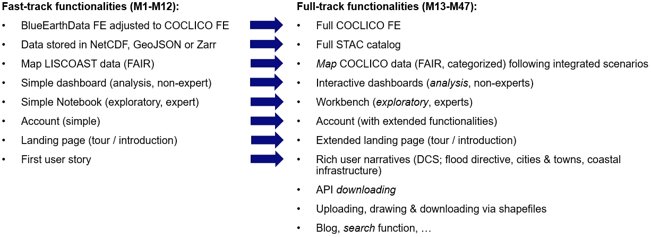
WP2 is responsible for developing the platform. The first step was to create the fast-track version. This was presented live to the whole consortium for the first time by Etiënne Kras and Floris Calkoen from Deltares. Thanks to WP2 leaders Deltares for developing it, and to Aristotle University of Thessaloniki for supporting its development.
The fast-track version includes:
Our partners in WP3-6 are working on the science and data that will populate the platform. These include projections across sea level, coastal hazards (erosion and flood), exposure and vulnerability (to people, infrastructure etc), risk and adaptation, and how to model these. We explored these WPs more deeply on day two.
Day 2. Data, Data, & More Data.
We dived into the specifics of what datasets will be used and how we can ensure that the data used is FAIR (that it is Findable, Accessible, Interoperable, and Reusable). The following diagram show the different elements of the CoCliCo platform development and how they interact to be FAIR.
Arjen Luijendijk from Deltares led the session on Integrated scenarios. We discussed how to prioritise our users, scenarios and datasets so as to provide the most comprehensive but viable outputs that are needed to address the pressing issues in coastal risk assessment and adaptation.
Remi Thiéblemont from BRGM led The Data Working Group review of our available data to ensure fluent interaction between datasets and the platform.
CoCliCo is multi-dimensional, covering typologies from physical, biological, social, and governance to platform design. Professor Robert Nicholls from University East Anglia led The Coastal Typology Working Group led the discussion to work on consistency and synergies between the typologies, work packages and final CoCliCo service. He also shared insights from the WCRP Sea Level 2022 Conference that he co-organised.
Similarly, Bart Van den Hurk from Deltares presented Knowledge Hub Sea Level Rise, a joint endeavour by JPI Climate and JPI Oceans held in Venice. It brought together key knowledge on the state and future of our coasts. We’ll feed the conclusions from both conferences into the development of CoCliCo.
Five early career scientists presented their research and how it will contribute to CoCliCo datasets and modeling.
Hedda Bonatz, Kiel University. Analysis of coastal population distribution in Europe.
Joël De Plaen, VU Amsterdam. Exposure and vulnerability of critical infrastructure.
Floris Calkoen, Deltares. Data-driven coastal change modeling at the continental scale.
Day 3. All The Rest.
To round up our workshop, day three covered the following five topics.
Assessing and representing uncertainties
Integrated scenarios
Policy brief
WP7 Communication, dissemination and exploitation
Platforms workbench demo
1) Assessing and representing uncertainties
As is with all scientific modelling, no platform claims to know and account for everything – if they do, be wary! How will we represent this uncertainty on our platform? What assumptions are we making, and what variables do we not know or can’t account for?
In each of our work packages, the uncertainty is different. The analysis assumptions will vary depending on the data and the factors involved. We need to consider this at an early stage, in terms of the hazards and risks, the users and the platform to recognise and address uncertainty where we can and communicate it clearly.
A good approach to assess this further is through case studies. By choosing case studies we have advanced knowledge of, we can assess the assumptions and uncertainties of the platform through a clear reference.
2) Integrated Scenarios
We walked through each data set to tease out the range of scenarios and their key indicators, the key drivers affecting that indicator, the limitations for generating data and details of the output. From here, we will integrate these to create scenarios in the platform.
3) Policy brief
Gonéri Le Cozannet introduced the policy brief that we are collaborating on with Protect and SCORE, two other EU-funded projects on coastal resilience. It will address the questions “When will a 2m rise in sea levels occur?” and “How might we adapt?”
Stay tuned for the key messages being presented at COP27.
4) WP7 Communication, dissemination and exploitation
We talked through the communication, dissemination and exploitation activities thus far and plans for the future, like collaborating with all the partners to build user stories. We also discussed the long-term vision; how CoCliCo will continue to add value after the project ends.
5) Platforms workbench demo
We closed the day with a demo of the platform’s workbench: Mapping coastal building footprints using STAC API and how we will enable external parties to use the data and code to expand the work of CoCliCo Services and make it Open Source.
With that, we parted ways! All in all, we had three very productive days and are stepping into year two aligned and motivated.
https://i0.wp.com/coclicoservices.eu/wp-content/uploads/2022/10/PXL_20221011_082006330-1-1.jpg?fit=4032%2C2268&ssl=122684032jacintahamleyvizzhttps://coclicoservices.eu/wp-content/uploads/2023/06/logo-coclico-color.pngjacintahamleyvizz2022-10-31 13:20:102025-03-04 12:27:01CoCliCo is One Year Old!
The consequences of sea-level rise and coastal flooding cannot be underestimated. With 7% of Europe’s population living in highly exposed coastal areas, we need to plan now to protect lives and economies in the future.
Authoritative data, based on the best available science, is needed now to support the decisions being made. All coastal European countries need access to accurate data and models and the ability to translate science into understandable, actionable knowledge to inform decision making:
Identifying priorities
Observing past trends
Exploring alternatives
Projecting the future
CoCliCo is a comprehensive system of coastal climate core services that is being developed to answer this pressing need.
It is a Pan-European web-based platform that will allow access to guidance to help inform policies and investments to ensure better adaptation to the implications of coastal climate change. It forms part of a cluster of European funded projects addressing coastal adaptation, creating an “ecosystem” of climate services.
The IPCC WG2 Climate Report published today is the most precise and up to date global assessment of impacts, vulnerability and adaptation to climate change available at this time. 270 authors from 67 countries contributed to this assessment.
Sea level rise represents a major threat for coastal communities, infrastructure and ecosystems during the 21st century and beyond. Thus, adaptation to sea level rise is one of the challenges addressed in this report.
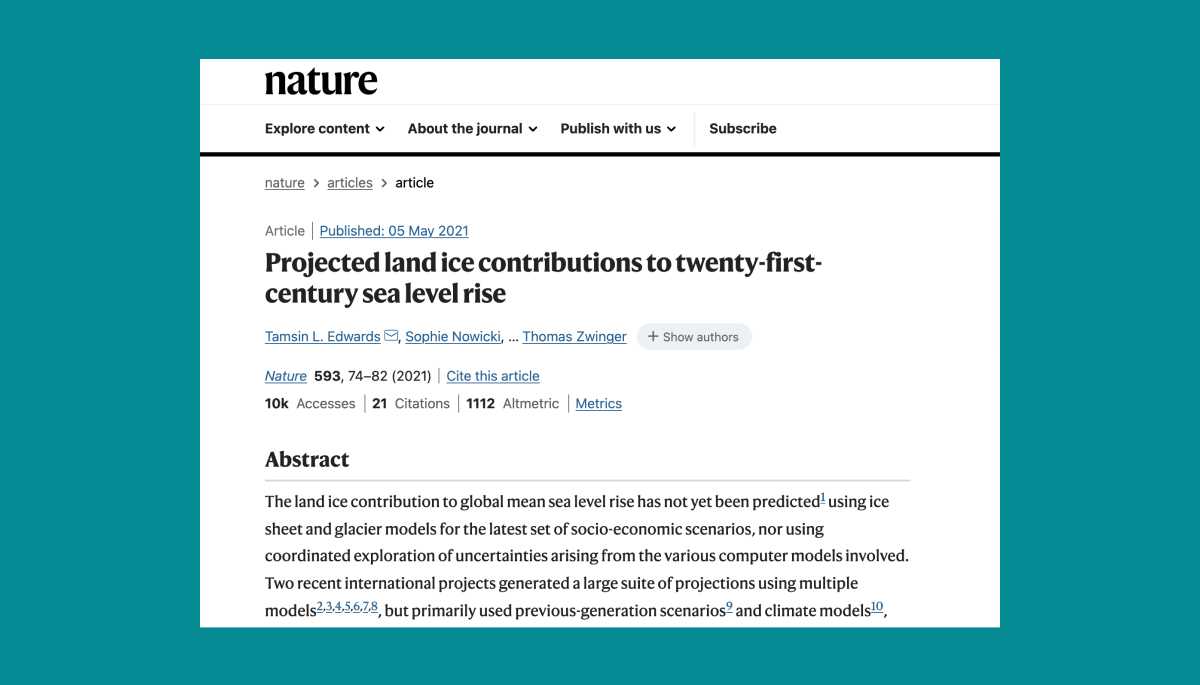
The sea-level projections delivered in July 2021 by WG1 are a major step forward. These projections are extended from 2100 to 2150 and they provide a quantitative estimate of a low-likelihood / high impact sea-level rise involving large ice mass losses in Antarctica and Greenland. Our sister project Protect Slr contributed to this assessment through new projections of ice mass losses.
Authoritative climate services will be needed to support adaptation: CoCliCo Services aims at developing a core service for coastal adaptation to sea level rise in Europe, in close cooperation with Copernicus Marine Service.
Adaptation alone will not be sufficient: urgent mitigation of climate change is needed to reduce sea level rise rates and give more time for adaptation planning and implementation, as well as to coastal ecosystems to migrate landward.
We may request cookies to be set on your device. We use cookies to let us know when you visit our websites, how you interact with us, to enrich your user experience, and to customize your relationship with our website.
Click on the different category headings to find out more. You can also change some of your preferences. Note that blocking some types of cookies may impact your experience on our websites and the services we are able to offer.
Essential Website Cookies
These cookies are strictly necessary to provide you with services available through our website and to use some of its features.
Because these cookies are strictly necessary to deliver the website, refuseing them will have impact how our site functions. You always can block or delete cookies by changing your browser settings and force blocking all cookies on this website. But this will always prompt you to accept/refuse cookies when revisiting our site.
We fully respect if you want to refuse cookies but to avoid asking you again and again kindly allow us to store a cookie for that. You are free to opt out any time or opt in for other cookies to get a better experience. If you refuse cookies we will remove all set cookies in our domain.
We provide you with a list of stored cookies on your computer in our domain so you can check what we stored. Due to security reasons we are not able to show or modify cookies from other domains. You can check these in your browser security settings.
Other external services
We also use different external services like Google Webfonts, Google Maps, and external Video providers. Since these providers may collect personal data like your IP address we allow you to block them here. Please be aware that this might heavily reduce the functionality and appearance of our site. Changes will take effect once you reload the page.
Google Webfont Settings:
Google Map Settings:
Google reCaptcha Settings:
Vimeo and Youtube video embeds:
Privacy Policy
You can read about our cookies and privacy settings in detail on our Privacy Policy Page.